My experience of working at Welfare State (later Welfare State International), included having a small part in a winter tour designed for rural communities. I always liked the way that Welfare State took their work out to communities rather than working in existing theatre buildings. However Stories for a Winter Night confirmed that this didn’t translate into attracting big audiences. I wanted Horse & Bamboo to work with rural audiences too, but I began to realise that I had to figure out a way of it reaching people more effectively.
I had the idea of a theatre tour pulled by horses. I knew almost nothing about horses, and we might still appear as unconventional as Welfare State did, but perhaps a horse-drawn theatre would provide an easier way-in for people? Either way, I felt that solving the audience problem would require a radical solution like this. We were, after all, trying to attract a village audience to an evening of experimental theatre, which was never going to be an easy task.
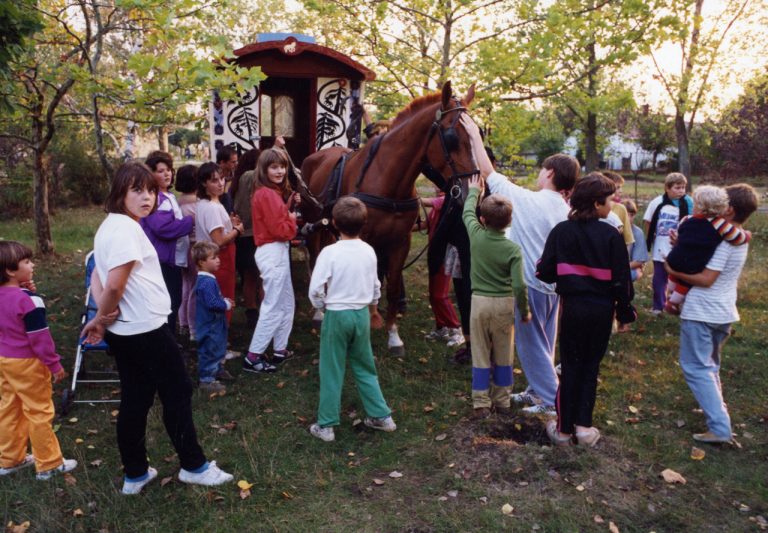
Over the first few years of touring with horses we moved from free shows set in the landscape to outdoor shows in a tented space. Then in 1982 for The Woodcarver Story we bought an ex-army marquee and toured for the following years with this, gradually extending it physically to accommodate larger audiences, until 1987. That year we took what seemed like a momentous decision and decided to perform in village halls, taking our shows into the community’s own space. This then became our normal procedure. In all of that time not one show had to be cancelled due to a lack of audience.
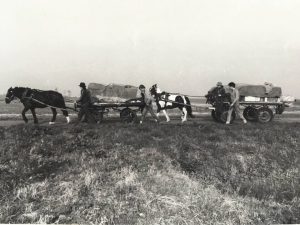
From the beginning the nature of horse-drawn touring created a very different type of company. It’s influence snuck into every part of our theatre practice. The performers had to sign up for a whole tour, 7 days a week, as the horses always needed looking after. Routes had to be checked out months ahead, along with tea-breaks and grazing stops, as well as over-night stays, and these were all routinely noted and necessary permissions were found.
On the whole the performers walked alongside or behind the carts, or drays. Each travel day we covered between 6 and 16 miles – rarely less, sometimes more. The routine was a show day alternating with a travel day, and one day off in seven – this way we managed three shows a week. Occasionally we would perform at a venue for longer than one night, but this was an untypical occurrence, though always welcomed. Everyone was super fit by the end of a tour.

Of course only a certain type of person signed up for this work, but on the whole it was a very successful model. Walking, cooking, camping and working together as a group really cements a company together. All of this spilled over into our theatre practice, and was responsible for creating strong bonds within the company. It wasn’t unusual for us to have a dozen or more people together on the road, each with their own tent; horse-drawn touring generally seemed to bring everyone closer together.
We started out with one horse and a donkey. The horse-handler became a crucial member of the company. Win Hunt joined us in 1979 and brought her horse and a donkey with his own special cart.
Over the years each horse-handler became an important part of the company. Win, then Jay Venn, Moira Hirst, Ellie Wood, Barry Lee, Liam Carroll, Sue Day, Graham Fell and Glen Wilson all became central figures in our group. Each had their own distinctive way of doing the job, which would subtly alter the way the rest of us worked together.
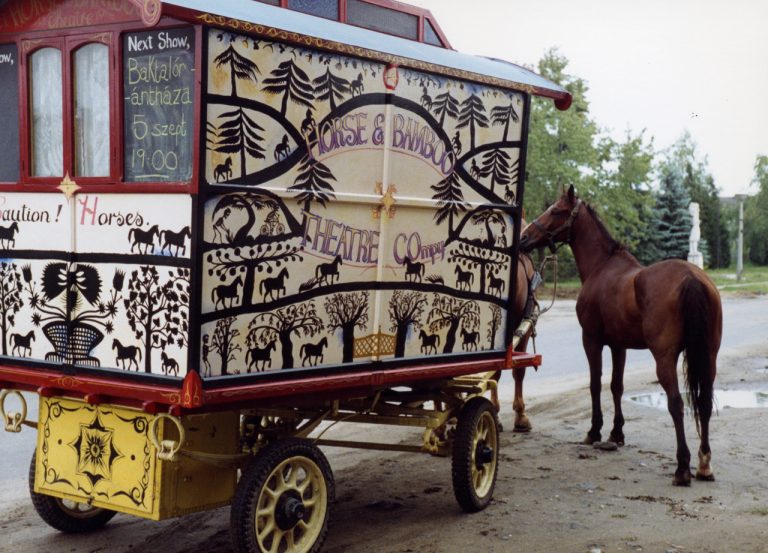
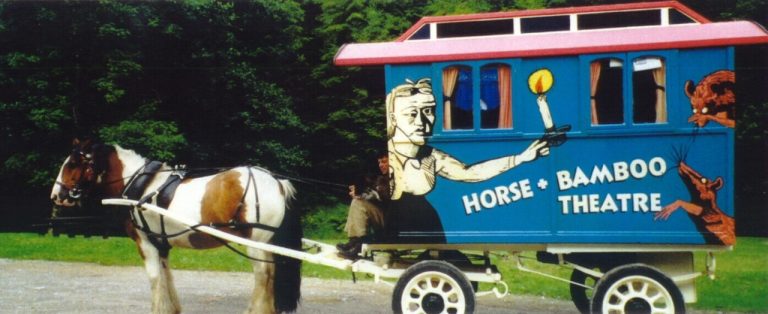
Soon we had three turnouts on the road as part of a tour, and members of the cast would be trained by the horse-handler to get to know the horses and handle the other drays. Two of the carts were flat-beds that carried the bulk of the show; the other was a painted wagon, originally made from scratch by Ele Wood. The wagon had a dual role in both advertising the company and the current performance, and providing us with shelter in bad weather. We also travelled with a back-up van that went ahead to check the routes and the venues, did our shopping, and usually carried the electrical and technical equipment.
Travellers
one unexpected spin off of horse-drawn touring was getting to know and meet up with travellers. Gypsies, people usually called them. We initially made contact with local travellers when buying and selling harness and horses. Working with horses provided us with a common currency and allowed a kind of understanding between us. Contact with travellers opened doors that we would otherwise have been excluded from.
During those first years as beginners we found ourselves in situations where individual travellers helped us out with practical advice and support. Harness that appeared impossible to find would be unearthed from some unlikely place; horses were found when we totally stuck; horse-transport to distant places turned up as if by magic. On a few occasions we found ourselves stranded away from home with a broken but critical harness strap or buckle. Then someone would appear from thin air and arrange for a replacement. We had a lot of help like this, and it usually came very willingly. It could easily have been taken for granted, but without the generosity of friends and strangers from within the travelling community, especially during those early years when we were learning the ropes, we would have found the whole enterprise far more difficult.
The summer tours gradually became more ambitious. By the mid 1980s we were touring the Outer Hebrides with horses, carts and a marquee. 9 islands in all, some of which meant sailing with our horses standing on the deck of a ferry. On one island, Berneray, the islanders resurrected an old custom of delivering the peats (which were cut and dried on a neighbouring uninhabited island) using our horse and cart. Later in the 80s we toured Ireland for the first time. After a hair-raising reconnaissance of the Border areas during the Troubles, when I got into so many scrapes zig-zagging between the Republic and the North, I decided that touring the Borders would be too stressful, particularly for horses. Military helicopters suddenly rising from a small woodland and buzzing a few deafening feet overhead; army patrols emerging from roadside ditches; midnight visits to the campsite. These were things that would have spooked the calmest horses, let alone performers. We eventually toured Northern Ireland, including much of the beautiful Antrim coast. Here we were made welcome in both in Orange and Catholic communities. Fittingly, it was in Ireland, in 2000, that we undertook our very last horse-drawn tour.
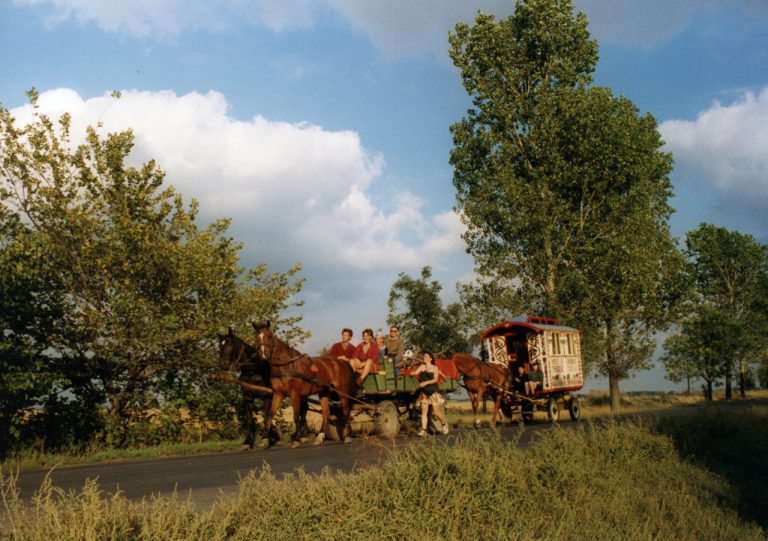
The end of horse-drawn touring
Eventually it all had to finish. Three things put paid to horse-drawn touring. First and most important, the majority of our tours had been commissioned by local authorities. By the mid-1990s local authorities arts budgets were disappearing fast, and so the funding simply dried up.
Second, the number of vehicles on British roads when we started horse-drawn touring was about 17 million. By 2000, when we pulled the plug, it was 28 million (now, in 2020, it’s 38 million). Motorways had proliferated too, and travelling from A to B was often far from straightforward for horse-drawn vehicles. Police forces were no longer able to provide us with an escort across busy major roads (there were usually one or two of these to be negotiated every summer). Put simply, it was all getting more dangerous. Motorists on country lanes no longer drove expecting a very slow moving convoy, 60 metres long, to be round the next corner. Near-misses became more frequent, and I felt that sooner or later there would be a serious accident. It was another reason to call a halt.
Finally, 90% of our press coverage was about the horses and our life on the road. At first it was exciting to get so much publicity for our tours. But by the 1990s we were producing some of the most interesting theatre work being done anywhere in the UK, but still all that everyone wrote about were the horses and way of life. This became increasingly frustrating, and along with the major issues mentioned above we needed a rethink – let’s have people write about our work, not just about our means of transport. Brilliant as it was.