One small event in 1981 turned out to have unexpected significance. We received a letter from a teacher who seen one of our shows at the Manchester Railway Exposition, which is now the Manchester Museum of Science & Industry. The letter explained how the writer, teaching at a special school, had been struck by how ‘hard-hitting’ the masks and archetypal themes we used were. He wondered if ‘the combination of visual overkill and massively mythic drama (could) be just the thing to break into the streams of unconscious that typify M.H.’ We discussed the letter with Kay Kennedy, who had just graduated from St. Albans as an art therapist. Then together we sat down and discussed what it would mean working within a special school environment.

The company were all cautious about undertaking this. But in the end we felt that we really wanted to take up the challenge, and talked a lot about how we might go about it. The basic format we came up with in 1981 then formed the template for a new strand of work for the next 25 years. Work that was challenging, exciting, stimulating, above all enjoyable and sometimes producing amazingly effective results. It became work that was increasingly popular with our performers and makers, and our extended family of artists queued to work on these events. From the beginning they came to be known collectively as Guided Imagery. GI projects became increasingly ambitious, and were some of the most successful and ground-breaking events that we ever undertook.

How it worked
At its simplest the format we devised was to start by welcoming small groups into a comfortable environment. The first thing was that we never talked about going to see theatre. Instead people came to whatever imaginary world formed the theme and subject for that particular project. We would say that it was a visit to a submarine, a narrow-boat, or a space rocket. We went to great lengths to make these spaces believable and realistic. Most of all they needed to be reassuring and friendly spaces.
Then, once everyone was settled, we went on a physical journey together. At first all would go well. When we felt that we had gained the group’s confidence, and that they trusted us as their guides, something unexpected would happen. In other words there would be an emergency of some kind. So lights would go out, flash on and off; there would be a jolt, some level of panic and noise. This stage was always very carefully managed, and how far the experience would be taken depended totally on the reactions of each group. All our effects, such as sound and lights, could be modified depending on the particular situation as it unfolded. Of course we had experienced guides on board too, able to respond directly to the participants, one-to-one.
After this the group had to decide how to deal with the problem. For people who lived in a situation where every decision was usually taken for them by carers, this was often a shock. It would be genuinely unexpected. Shall we use the emergency door to find our own way back? Can we try and repair the engine? Should we send a volunteer ahead to see how things were outside? It would be an anxious period involving problem solving, group bonding, and sometimes acts of real emotional courage.
The final stage always involved resolving the problem, and successfully returning to normality. Meaning back to the starting point, to ‘home’. But now with an enhanced sense of achievement and self-worth in having overcome the problem. Inevitably this would include a sense of relief and a celebration of what had been achieved together.
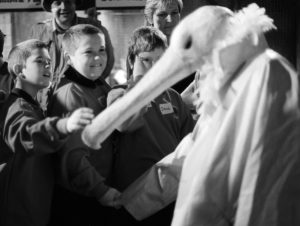
So, there were four distinct stages. These sessions would usually last between two and three hours. In most cases, after a lunch period, we then returned to the GI environment and looked again at the illusory journey. Where appropriate sharing the fact that we had all played a part in a game. This would be followed by a short making, play or acting session.
The work that went into constructing these complex built environments was enormous. We built the ‘vehicles’, the safe rooms, and the unsafe worlds that the participants were thrown into. Plus, of course, the ‘escape route’ out of this world. The Guided Imagery environments filled large halls and would take a team of between 6 and 8 artists up to 6 weeks to construct.
On most Guided Imagery projects there would be one group visiting each day. A group would normally consist of 10 participants, plus their carers – 1, 2, 3 or more depending on the make-up of the group. Every space had to be wheelchair accessible, and every environment had to fully controllable by the performers. Our cast also operated the sound and light (and sometimes the smells) that helped create the sense of a actual journey.
Over this 25 year period we created a menagerie, complete with an aquarium, insect house, and underground caves; a flight to the moon; a journey from a water research laboratory to a subterranean lake complex; a haunted shoe shop; a fairground; a window manufacturers; an island; a jungle; a fish and chip shop that led to a trawler which in turn sailed to a desert island and lighthouse; a narrow-boat journey, involving a labyrinth that took us beneath a castle. Each day the show would vary too, as performers responded to the reactions of particular participants, to their fears, their triumphs, their ideas and their own contributions to the journey that we were taking together.